19 October, 2026 | 8:22 PM


The battle for Tamil Nadu begins
26-01-2026 12:00:00 AM
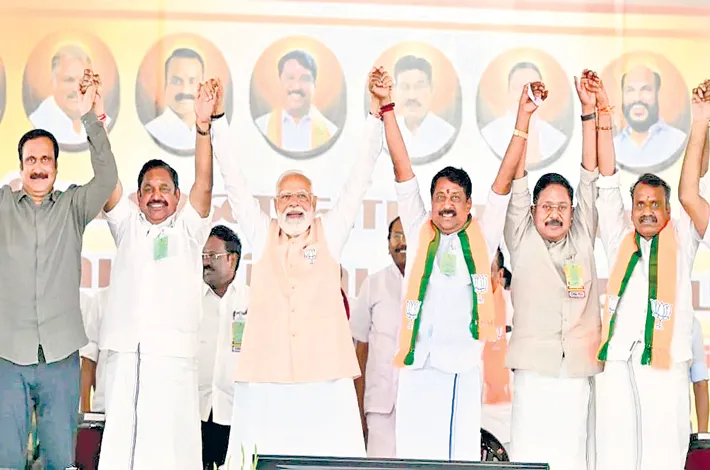
In a charged political atmosphere, Tamil Nadu is witnessing an intensifying battle between the Dravida Munnetra Kazhagam (DMK)-led alliance and the National Democratic Alliance (NDA) as the state gears up for the 2026 assembly elections. Prime Minister Narendra Modi descended on Maduranthakam for a massive NDA rally, marking the unofficial launch of the coalition's campaign. The event, attended by leaders from various factions including the Bharatiya Janata Party (BJP), All India Anna Dravida Munnetra Kazhagam (AIADMK), Pattali Makkal Katchi (PMK), and Amma Makkal Munnetra Kazhagam (AMMK), showcased a united front against the ruling DMK.
Modi declared war on the DMK, accusing it of corruption, mafia links, and crime—coining the acronym "CMC" for Corruption, Mafia, Crime—while reiterating the BJP's commitment to Tamil Nadu's development. He contrasted this with the NDA's achievements, claiming it had done more for the state than the previous United Progressive Alliance (UPA) government and invoking the legacy of late AIADMK leader J. Jayalalithaa.
This show of unity underscored ongoing seat-sharing discussions within the alliance. Beyond corruption, Modi touched on issues like women's safety, the need for "double-engine" governance to secure central funds and projects, and cultural preservation. He specifically referenced the Karthigai Deepam controversy at Thiruparankundram, accusing the DMK of exploiting the issue for vote-bank politics and acting against devotees' rights to light the traditional lamp. Modi positioned his government as a staunch defender of such religious traditions, contrasting it with the DMK's alleged disdain.
A senior Tamil journalist noted the significance of Modi's references to the Deepam row, the impeachment of a judge, and especially the drug menace, which the Prime Minister highlighted multiple times. Gopalan suggested that the speech combined these elements to convey a broader message of change in Tamil Nadu. He observed visible enthusiasm among NDA leaders on stage, interpreting Modi's words as echoing criticisms previously voiced by state BJP chief K. Annamalai, and signalling the potential end of the DMK's regime amid rising anti-incumbency.
DMK Chief Minister M.K. Stalin fired back sharply on social media, alleging the NDA as a "daapa engine" (implying a flawed or "poor" engine) and not as a “double engine”. In his post, Stalin defended Tamil Nadu's progress under DMK rule, stating, "Despite all the barriers imposed by the Union BJP government, Tamil Nadu has achieved the kind of development that history speaks of by shattering them." He compared opposition-ruled states like Tamil Nadu, Kerala, Telangana, Karnataka, and West Bengal—where the BJP's influence is minimal—to BJP strongholds such as Uttar Pradesh, Madhya Pradesh and Bihar, arguing that the former are "soaring high in development." This retort escalated the rhetoric, turning the rally into a direct ideological clash over governance models and federalism.
A DMK spokesperson dismissed the NDA's prospects, sarcastically welcoming more visits by Modi, claiming they had historically benefited the DMK by alienating voters. He accused the BJP of hypocrisy on corruption, pointing to allies like those facing charges and selective outrage over dynasty politics. He argued that Tamil Nadu's electorate was literate enough to see through the NDA's narrative and that issues like religious sentiments carried little weight in the state, where non-spiritual concerns dominated voting patterns. He also highlighted central withholding of funds and alleged misuse of the Governor's office as key grievances against the BJP-led centre.
BJP leaders clarified the "daapa engine" as referring to the DMK's failures, contrasting it with the NDA's "double engine" model of aligned central-state policies. He reiterated central funds devolved to Tamil Nadu, exceeding UPA allocations. AIADMK leaders emphasized the NDA's synergy, calling it a united front against DMK's "misrule" and "dinosaur" governance. They highlighted ground-level cadre enthusiasm and criticized the DMK alliance for internal uncertainties, such as Congress demands for 117 seats and power-sharing, which remain unresolved. Congress's however defended the alliance as intact and ideologically driven, noting ongoing seat-sharing talks as natural. A Congress leader mocked the NDA as a "dappa sarkaar" forced together by fear of central agencies like ED and CBI, pointing out Modi's speech omitted mentions of AIADMK or its two-leaf symbol, suggesting BJP dominance.
A political analyst Sumant Raman viewed the rally as an impressive start for the NDA, crediting the onstage unity and TTV Dhinakaran's endorsement of EPS. He suggested the contest is narrowing to a two-horse race between AIADMK-led NDA and DMK alliances, potentially tilting further if Vijay aligns with NDA. However, he noted DMK's strategy to fragment the opposition into multi-cornered fights may falter.
With elections still months away, the arguments laid bare the core fault lines: the NDA's focus on corruption, law and order, drugs, women's safety, and cultural/religious issues versus the DMK's confidence in its alliance stability, anti-incumbency counters, and accusations of central interference. The campaign launch and subsequent television clash set the tone for what promises to be a fiercely contested battle in Tamil Nadu, blending national narratives with deeply local sentiments.