12 October, 2026 | 4:40 AM


Women’s reservation, delimitation, and constitutional tightrope
18-04-2026 12:00:00 AM
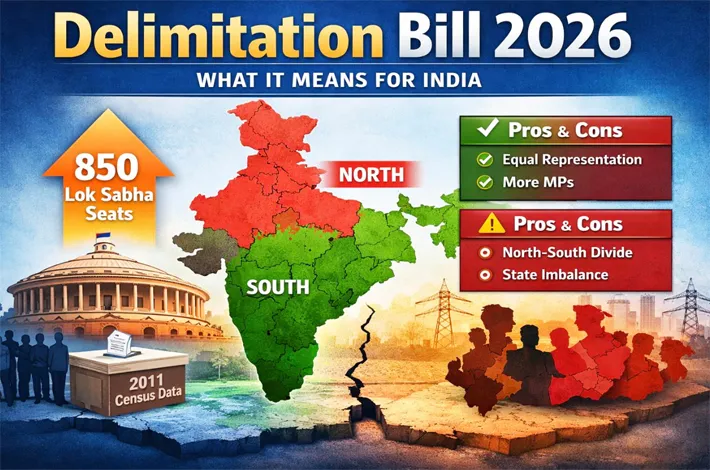
Why is delimitation so politically sensitive?
2026 “Triple Bills”: The reform comes through three coordinated Bills:
■ The Constitution (131st Amendment) Bill, 2026 aims to operationalize the long-pending 33% reservation for women in Parliament and State Assemblies in time for the 2029 general elections.
■ The Delimitation Bill, 2026 proposes the creation of a fresh Delimitation Commission to redraw constituency boundaries.
■ The Union Territories Laws (Amendment) Bill, 2026 extends women’s reservation to legislatures in Delhi, Puducherry, and Jammu & Kashmir.
■ Increase Lok Sabha seats from 543 to around 816–850.
■ Expand each state’s representation by roughly 50%.
■ Preserve existing proportional shares across states.
Metro India News | Hyderabad
In April 2026, Parliament embarked on what may become one of the most consequential electoral reforms since independence, a three-part legislative package that seeks to expand the Lok Sabha, implement women’s reservation, and redraw constituency boundaries. At first glance, the move appears to resolve a decades-old political dilemma. But beneath the surface lies a complex constitutional puzzle that could invite intense judicial scrutiny.
Since the 1970s, seat allocation among states was frozen based on the 1971 Census. This was done to protect southern states, which had successfully controlled population growth, from losing representation to faster-growing northern states. This freeze, embedded in Articles 81 and 82, was meant to last until after the first Census conducted post-2026.The government is attempting something unusual-to expand representation without redistributing power. Its key innovation is the “uniform expansion” formula:
For example, Tamil Nadu’s share would remain around 7.2%, Karnataka around 5.1%, and Andhra Pradesh roughly stable, despite the increase in absolute numbers. Instead of dividing the same pie differently, make the pie bigger for everyone.
Where does the constitutional tension arise?
The proposal runs into immediate friction with the Constitution, especially Articles 81 and 82. Most important is the “Sunset Clause” Problem. The Constitution clearly states that seat reallocation should happen only after the first Census post-2026.The government’s plan: use 2011 Census data now. And the constitutional design: wait for future Census data. This creates a direct legal conflict.
What is the government’s defense?
The government’s argument is pragmatic: India needs more representatives for a growing population. It states that women’s reservation cannot be delayed indefinitely and that a uniform increase avoids punishing any region. In essence, it is proposing a mathematical workaround to a political problem.
What lies ahead?
This reform sits at the intersection of three competing imperatives: a) Demographic reality (more people, more MPs), c) Gender justice (women’s reservation) and c) Federal balance (state-wise power equilibrium). The 2026 “Triple Bills” are not just about adding seats or reserving constituencies. They attempt to rewrite the rules of representation without reopening old regional fault lines. Whether this careful balancing act holds or collapses under constitutional scrutiny will likely be decided not just in Parliament, but in the courtroom.
(Prof Madabhushi Sridhar is Dean, School of Law, Mahindra University and former professor, NALSAR Hyderabad.)