28 October, 2026 | 5:12 AM


AI Agent Maturity at India’s Big Hackathon
03-02-2026 12:00:00 AM
Venkat Parsa | Hyderabad
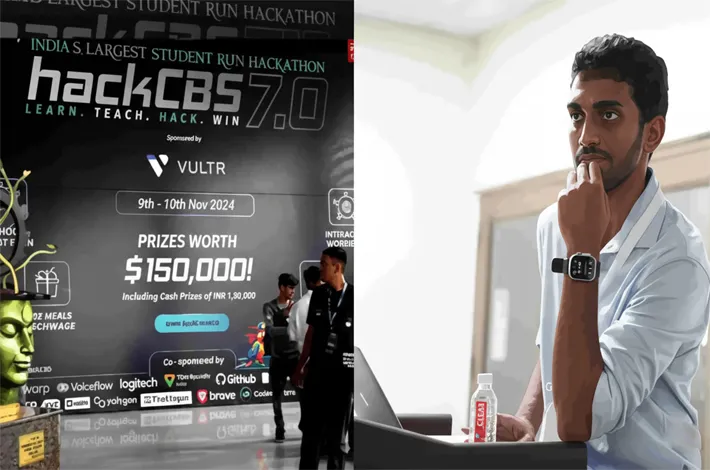
Young Indian Coders making innovative strides in Artificial Intelligence was revealed at the India's largest student-run Hackathon and Asia-Pacific's first Major League Hacking (MLH). Among 14 selected judges chosen from 140 applicants was Pranay Mandadapu, a US-based software engineer, specializing in AI and full-stack development. In his current role, he develops Healthcare Solutions.
Pranay Mandadapu's journey from winning and placing in Hackathons in India and the US to judging the country's premier event, highlights the global Indian tech diaspora. As founder of UWM's Google Developer Student Club, he was invited to Google HQ in 2022. "India's students are the DNA of tomorrow's AI revolution," he said. "Events like HackCBS prove they're not just participants, they're leaders."
Mandadapu, who earned his Master's in Computer Science from the University of Wisconsin-Milwaukee (UWM) on full merit-based scholarships, including Chancellor's Awards and teaching assistantships, and has a track record of AI Innovations, shared exclusive insights on the maturity of AI systems emerging from the event.
"Judging HackCBS was an eye-opener," said Mandadapu. "These students aren't just Coding Apps; they're building sophisticated AI Solutions that demonstrate real-world readiness, from autonomous decision-making to ethical integrations."
As AI technologies mature, HackCBS 8.0 signals India's rising prominence in global tech. Held on November 8-9, 2025, at Shaheed Sukhdev College of Business Studies in Delhi, the offline extravaganza drew over 4,400 attendees from more than 700 colleges across 440 cities and 25 countries.
With themes spanning Artificial Intelligence, GenAI, FinTech, Health Tech, and Web3, participants tackled real-world challenges, vying for prizes totaling over $220,000, including special awards for Best Use of GenAI and Best Blockchain Innovation.
Mandadapu's expertise stems from his own innovative work in AI. As an undergraduate at GITAM University in Visakhapatnam, he won first place at the 2019 SWISH Hackathon, organized by GITAM with Japan's DENSO Group, for a crop management application, a feat covered by The Hans India. His lead-authored Springer book chapter, Gideon An Artificial Intelligent Companion, explored AI companions using TensorFlow and OpenCV; it was selected as a top paper at his university, leading to a team presentation at the 2018 Jnana Bheri event, in the presence of Andhra Pradesh Chief Minister Nara Chandrababu Naidu.
From the judge's desk, Mandadapu observed a notable evolution in AI system maturity. "Many projects showcased collaborative AI systems, intelligent entities working like a team, handling complex tasks in real-time," he explained.
Mandadapu said, "One standout entry used GenAI for IP protection, detecting and responding to threats with minimal human input, earning runner-up honors. Compared to US hackathons like CalHacks in San Francisco, where I mentored just a month earlier in October 2025, Indian students are closing the gap remarkably fast. At CalHacks, the epicenter of the AI boom with global participants turning ideas into production-ready products, the bar was high due to massive investments. But hackCBS didn't disappoint; I was shocked at the level of thinking here, where students and professionals matched US standards with far fewer resources. They're integrating ethical AI frameworks early, addressing biases in datasets something that's becoming a global standard."
The Hackathon's scale amplified these trends. With 15,800 registrations, teams prototyped solutions in under 36 hours, often incorporating cloud and IoT for scalable AI systems. Mandadapu noted challenges too: "While creativity is high, scalability remains a hurdle for some. Students need more access to advanced compute resources to push system autonomy further." He praised organizers for fostering inclusivity, including workshops and mentorship from industry pros.
For Mandadapu, it's a full-circle moment: "From competing in Visakhapatnam, to innovating in the US, to evaluating Delhi's brightest it's inspiring to see how far we've come."