19 October, 2026 | 2:56 PM


India-EU Trade Pact: A Game-Changer
28-01-2026 12:00:00 AM
At the heart of the deal are substantial tariff reductions. India will eliminate duties on 93% of EU goods over the next decade, while the EU will provide nearly zero-duty access for more than 99% of Indian exports by trade value over seven years. This includes immediate or rapid tariff cuts on sectors such as aircraft, gems and jewellery, machinery, chemicals, electrical equipment, and pharmaceuticals
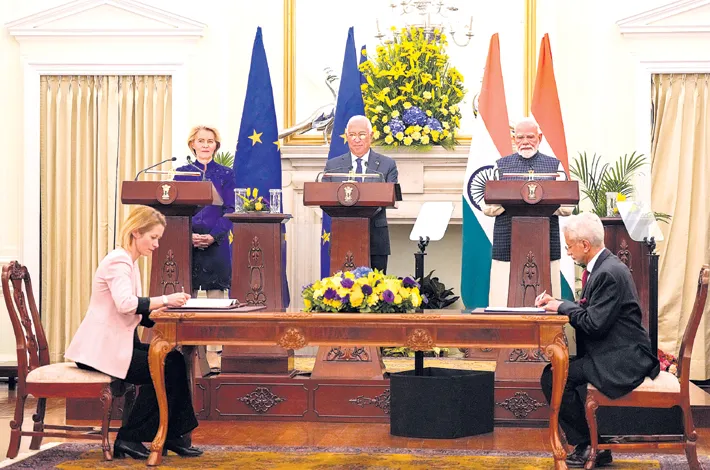
In a historic move that could redefine global trade dynamics, India and the European Union announced a landmark free trade agreement (FTA) on January 27, 2026, at the India-EU Summit in New Delhi. Often called the “mother of all deals,” the agreement culminates nearly two decades of negotiations and creates a massive trade zone covering around 2 billion people, roughly a quarter of the world’s GDP, and one-third of global trade. Leaders from both sides hailed the pact as a strategic pivot in a world increasingly shaped by protectionism and geopolitical rivalries.
European Commission President Ursula von der Leyen, European Council President António Costa, and Indian Prime Minister Narendra Modi unveiled the agreement alongside Trade Minister Piyush Goyal. Goyal described it as a transformative deal that not only reduces billions in tariffs but also strengthens critical supply chains, signalling a new era of economic collaboration and diversification away from overreliance on dominant powers like the United States and China.
The pact’s journey began in 2007 with high hopes of linking the EU’s massive single market with one of the fastest-growing economies in the world. However, negotiations stalled in 2013 over market access, regulatory standards, and intellectual property issues. Talks regained momentum in 2022, driven by global supply chain disruptions, rising trade tensions, and India’s push for economic modernization.
At the heart of the deal are substantial tariff reductions. India will eliminate duties on 93% of EU goods over the next decade, while the EU will provide nearly zero-duty access for more than 99% of Indian exports by trade value over seven years. This includes immediate or rapid tariff cuts on sectors such as aircraft, gems and jewellery, machinery, chemicals, electrical equipment, and pharmaceuticals. For European businesses, the deal is expected to save up to €4 billion annually.
Sector-specific benefits are substantial. Indian car tariffs, previously over 110%, will drop to as low as 10% within quotas, with car parts tariffs fully eliminated in 5–10 years. Tariffs on EU alcoholic beverages and food products will see major reductions, with spirits duties cut to 40%, beer to 50%, and wine to 20–30%. Olive oil, margarine, and vegetable oils will also enjoy reduced tariffs. Meanwhile, India gains zero or nearly zero tariffs on around $33 billion worth of labour-intensive exports, including textiles, apparel, leather, footwear, marine products, gems, jewellery, handicrafts, engineering goods, and automobiles.
Despite the sweeping benefits, sensitive sectors have been cautiously protected. India has limited access for certain automobile categories, steel, dairy, and select agricultural products to safeguard domestic producers. Environmental and labour standards were also negotiated, with the EU accepting limited initial provisions. A major sticking point, the EU’s Carbon Border Adjustment Mechanism implemented in January 2026, was addressed to ensure smooth trade flows in carbon-intensive goods.
The agreement also includes a broader vision for sustainable growth. The EU will provide €500 million over two years to support India’s greenhouse gas reduction and sustainable industrial transformation. Emphasis is placed on MSMEs, job creation—particularly for women, youth, and artisans—and expanding trade in services like IT, telecommunications, and professional sectors.
Bilateral trade, currently around €180 billion annually in goods and services, is projected to grow sharply. Indian exports to the EU could increase by $50 billion by 2031, while EU exports to India are expected to double by 2032. Services trade, already robust at €37 billion in 2024, is likely to benefit from liberalized access, strengthening sectors where both economies hold global leadership.
The deal is not just economic but geopolitical. By linking two of the world’s largest democracies, it creates a counterbalance to trade volatility from the US and China. India’s recent trade spree, including agreements with the UK, New Zealand, Oman, Australia, and the European Free Trade Association, reflects a strategy to modernize its economy and attract foreign investment. Indian exporters, hit by declining US sales, have welcomed the pact as a chance to diversify markets and mitigate global trade risks.
Challenges remain. Ratification by the European Parliament and India’s cabinet is required, and stakeholders such as EU farmers or Indian protectionists may scrutinize the deal. Past FTAs have sometimes failed to deliver projected export gains, prompting economists to caution that success depends on implementation and addressing non-tariff barriers. Meanwhile, US negotiations remain stalled, with disputes over trade outreach in 2025 highlighting the complex geopolitics surrounding India’s trade strategy.
In essence, the India-EU FTA is more than a commercial agreement; it is a statement of strategic intent. By connecting nearly two billion people and a quarter of the global economy, it demonstrates how middle powers can collaborate to build resilience in an uncertain world. For India, it accelerates its emergence as a manufacturing hub; for the EU, it ensures a strong presence in Asia’s growth story. As the world grapples with protectionism, climate imperatives, and shifting alliances, this deal may well be remembered as a defining moment in global trade.