19 October, 2026 | 1:50 PM


Unbelievable that Venigalla is no more
29-01-2026 12:00:00 AM
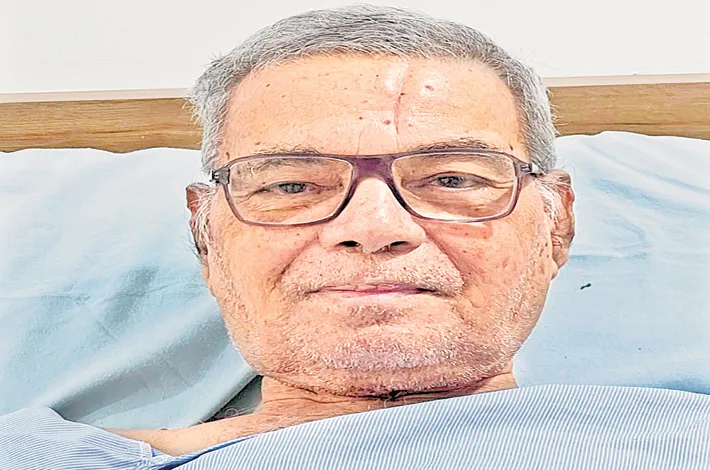
His affable nature had an inexplicable charm that drew people in. It was a blend of warmth and affection that defined him. His hospitality was unparalleled, but above all, one could learn from his culture of respecting others
It is hard to believe that Venigalla Venkata Ratnam is no longer with us. Tears still well up in my eyes at the thought. The news of his passing came to me on the evening of the 24th through a post by Bhandaru Srinivasa Rao. I had just arrived in another town for work at that time, and since then, my mind has been restless. Yesterday, on the morning of the 27th, I went with my friend Kondiah to TRR Medical College in Ainavolu, Sangareddy district, to pay my respects to his mortal remains.
Even now, accepting that Venigalla is gone feels incredibly difficult. He lived a blessed life, for the greatest wealth he amassed was his circle of friends. Yesterday, they all gathered, along with his family members, and in the presence of hundreds of young doctors, his body was donated to the medical college as per his wishes. What more could Venigalla have asked for? Born in some remote village called Govada, Venigalla joined the Public Relations department at Coromandel Fertilizers and retired from the same role about two decades ago.
His affable nature had an inexplicable charm that drew people in. It was a blend of warmth and affection that defined him. His hospitality was unparalleled, but above all, one could learn from his culture of respecting others. Once you met him, he would always be the one to greet you first. His special quality was his sociable demeanor. He had an insatiable thirst for literature—a voracious reader, a lover of literary works, an analyst, and a writer himself.
He even managed an art magazine. He was close to many luminaries like Chalasani Prasada Rao, Narishetti Innayya, Sahavasi, D. Venkataramayya, C. Bhaskara Rao, Vasireddy Naveen, Koka Sanjeeva Rao, Dandamudi Mahidhar, Perspectives RK, and Peacock Gandhi—they were all his intimate friends and soulmates. Norman Borlaug, the scientist who tirelessly worked and inspired countless others to use science for a hunger-free world, was someone Venigalla had the privilege of interviewing.
Coromandel had instituted an award in Borlaug's name, and when he visited Delhi in 1983 for the occasion, Venigalla conducted a special interview that was published in Andhra Prabha. No one else in the Telugu media seemed to have thought in that direction back then. Scientists like Dr. M.V. Rao worked alongside him, as I recall. Coromandel compiled the award's guest lectures into a book, and Venigalla always wished to translate them into Telugu.
As long as Sahavasi was around, Venigalla would unfailingly meet every week or every other week at the Press Club with D. Venkataramayya and RK. I was part of those gatherings too. After Sahavasi's passing, he continued meeting monthly with D. Venkataramayya and Koka Sanjeeva Rao near Miyapur, and I was a member there as well. I remember Gandhi joining us once or twice. At Eenadu's opposite Press Club, from senior journalist VJM Diwakar to club manager Ram Chander, everyone considered Venigalla a close friend. It's no exaggeration to say his friendships were that strong. He had a special affection for Hindu and Business Line's Somasekhar.
He regularly attended seminars at CESS. My friend, the agricultural economist and Cornell University professor N. Chandra Sekhar Rao, was someone Venigalla admired immensely. Even three days before his death, during our last conversation, he spoke at length about Chandra Sekhar and his research. Poets, literary scholars, writers—he interacted intimately with people from all fields, making his life rich with such connections. He had an enormous love and admiration for Tenali, which he honored by publishing a book titled "Andhra Paris: Tenali."
Sanjeev Dev was like an obsession for him, leading to another book about him. He desired to compile Sahavasi's writings and translations comprehensively, and the same for D. Venkataramayya. As for me, I don't clearly remember how we first met. He had good relations with Akashvani's Rambabu, Devadas, Suman, and Nagamalleswara Rao too. He stood like a rock in support of our movement to sustain public broadcasting systems, insisting that Akashvani and Doordarshan should focus on development journalism rather than commercialism. He wrote two or three articles on it and even got some prominent figures in Delhi to write letters. Just a week before his passing, he asked me to send my recent book on agricultural journalists, which I rushed via speed post. Little did I know those would be his last words. Gandhi, his son Pururava, and I visited him twice together. Rythu Nestham's Venkateswara Rao suggested we meet the elder, and we thought of Misimi editors Ashwini Kumar and Rambabu, but Gandhi said let's all go together. Before we could plan it, he left us, leaving an irreplaceable void for his friends. Elders pay tearful tributes to Venigalla.
( V.Gopichand The author is a retired senior journalist at All India Radio )