19 October, 2026 | 12:49 PM


Railway Budget 26 What’s on track
29-01-2026 12:00:00 AM
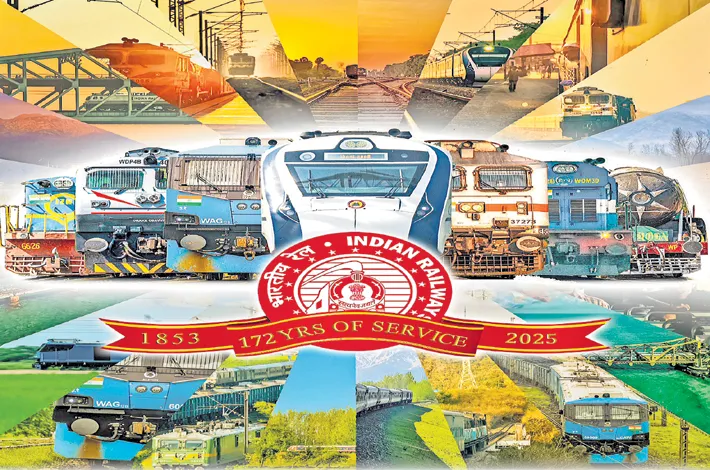
The Indian Railways has evolved far beyond merely operating tracks and trains. It has become one of the largest engines of capital expenditure (capex) in the Indian economy. In recent years, railway spending has reached record highs, with improved execution and robust order inflows providing multi-year visibility for companies across sectors—from engineering, procurement, and construction (EPC) firms and rolling stock manufacturers to signaling and electrical players.
Economists as well as veterans from various fields, while praising Indian Railways as one of the world's best organizations, credit its expertise while acknowledging its complexities—operating through villages and dense cities alike. They emphasized that for India to achieve 8% GDP growth, railways must grow at least 10%, maintaining a consistent 2% differential to support overall economic expansion. Reflecting on past constraints, they noted that previous administrations faced resource limitations, but the current government has provided unprecedented funding—around Rs 2.5 lakh crore—marking a record that has put railways on a strong path of progress. They also expressed strong optimism that the upcoming budget would be very positive for the sector and the broader economy.
A senior BJP leader highlighting the transformative impact of merging the Railway Budget with the Union Budget since 2017 (following the last standalone railway budget in 2016). This shift has dramatically increased Gross Budgetary Support (GBS), rising from just Rs 24,000 crore in one earlier year to Rs 2.5 lakh crore sustained over the last two years. He described this level as potentially optimal but argued that, given strong utilization (around 80-81% by December), railways have a rightful claim for about 15% more allocation to address languishing projects. He mentioned that over the 2014–2024 decade, railways received Rs 8 lakh crore in GBS compared to Rs 1.5 lakh crore in the prior decade (2004–2014). While major announcements may be limited in a merged budget, he saw strong potential for announcements on three new dedicated freight corridors and related allocations.
The discussion turned to government priorities within railway spending. A retired bureaucrat stressed two key areas: budgeting and management structure. He advocated avoiding mismatches in expertise—comparing it to not assigning a liver specialist to heart surgery—and called for greater private sector involvement through public-private partnerships (PPP). He argued that no railway globally sustains profits solely on public funds, and private investment is essential, especially beyond rolling stock, to overcome delays from government tendering processes. He hoped the budget would strongly promote PPP frameworks to unlock required investments.
A Congress leader addressed concerns that higher capex has not always yielded proportionate service improvements. He acknowledged decades of underinvestment that hindered capacity augmentation, limiting railways' ability to meet industrial and manufacturing demand. Now, with capex at Rs 2.5 lakh crore (plus a revenue budget around Rs 3 lakh crore, totalling ~Rs 5.5 lakh crore), the focus must shift to better project management.
An industry representative highlighted persistent time and cost overruns—citing a Ministry of Statistics report noting 26 of 51 delayed projects were railway-related—and stressed close monitoring, outcome audits, and learning from successes like completed dedicated freight corridors (which, despite comprising only 4% of rail kilometers, handle 14% of net tonne kilometers). He expected continued Rs 2.5 lakh crore support but urged railways to prioritize high-impact projects. On freight movement, he described a robust freight system as the lifeline of any economy, crucial for controlling food inflation and overall efficiency. While passenger services remain vital in a developing nation like India, he called for accelerated freight modernization to strengthen economic robustness.
A senior Supreme Court lawyer and consumer rights activist delved into passenger fares, noting that two-thirds of earnings come from freight (Rs 1.88 lakh crore estimated this year) versus passengers (Rs 92,000 crore). Recent minimal fare hikes have yielded little additional revenue (Rs 2,000–2,500 crore), while subsidies remain high—around 45 paise per passenger kilometer, causing annual losses of Rs 50,000–60,000 crore, offset by freight cross-subsidization. He argued this model is unsustainable long-term and advocated gradual, incremental fare increases over 5 years to reach break-even, paired with improvements in comfort, safety, and efficiency. Bold steps, like those in 2012, are needed again.
Finally, addressing inequality between premium and non-premium travel, an infra expert favored a generational change rather than incremental tweaks—modernizing stations (leveraging real estate via PPP), reducing interference to maintain motivation among dedicated railway staff (from gangmen to the board chairman), and granting them autonomy with clear tasks and timelines. He reiterated full confidence in railways' delivery if resourced properly. As the Union Budget approaches, the panel's insights underscore expectations of sustained high capex (potentially with modest increases), focus on execution, PPP acceleration, freight corridors, project efficiency, and balanced reforms to ensure railways continue driving India's economic growth. All eyes remain on February 1 for concrete signals on these fronts.